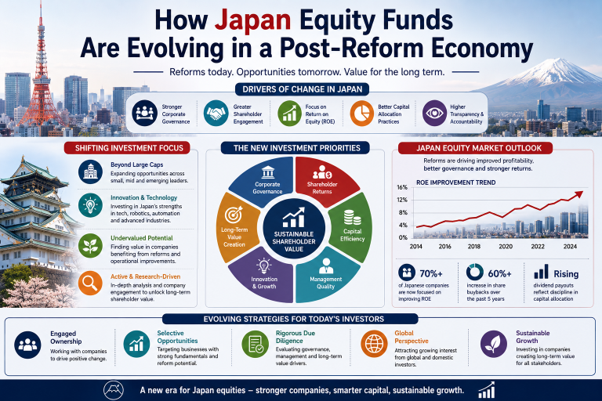
Japan’s economy and corporate sector have undergone significant changes over the past decade. Corporate governance reforms, shareholder-focused initiatives, improved capital allocation practices, and a renewed emphasis on efficiency have reshaped how investors view Japanese equities. These developments have not only influenced individual companies but have also transformed the way investment managers approach the Japanese market.
The growing popularity of the Japan equity fund reflects increasing investor confidence in the country’s evolving economic environment. As reforms continue to influence corporate behavior and market dynamics, fund managers are adapting their strategies to identify opportunities that may benefit from these long-term structural changes.
An effective investment due diligence process has become increasingly important in this environment, as managers seek to evaluate companies based not only on financial performance but also on governance quality, capital efficiency, management discipline, and long-term growth potential.
Understanding Japan’s Post-Reform Economy
For many years, investors viewed Japan as a mature economy with limited growth prospects and corporate structures that were often resistant to change. However, a series of reforms aimed at improving economic competitiveness and corporate governance have gradually altered that perception.
Key areas of reform have included:
- Enhanced corporate governance standards
- Greater board independence
- Improved shareholder engagement
- Increased focus on return on equity
- Better capital allocation practices
- Higher levels of corporate transparency
These changes have encouraged companies to become more accountable to shareholders while improving operational efficiency and strategic decision-making.
Shifting from Traditional Investment Approaches
Historically, many Japan-focused funds concentrated on large, globally recognised corporations. While these companies remain important components of investment portfolios, managers are increasingly expanding their focus.
Modern fund strategies often look beyond traditional market leaders and explore opportunities among:
- Small-cap companies
- Mid-cap businesses
- Niche industry leaders
- Technology innovators
- Corporate turnaround situations
This broader opportunity set reflects growing confidence in the depth and diversity of Japan’s corporate sector.
Fund managers recognise that reforms have created value-creation opportunities across multiple segments of the market, not just among large multinational companies.
This shift has contributed to a more active and research-driven investment environment.
Increased Focus on Corporate Governance
Corporate governance has become one of the most influential factors shaping the evolution of equity funds in Japan.
In the past, governance considerations often played a secondary role in investment decisions. Today, they are frequently central to the investment process.
Fund managers increasingly evaluate factors such as:
- Board composition
- Capital allocation policies
- Shareholder communication
- Executive accountability
- Strategic planning effectiveness
Companies demonstrating strong governance practices may be viewed as more attractive investments because they are often better positioned to create sustainable shareholder value.
Improved governance standards have also increased investor confidence, encouraging greater participation from both domestic and international investors.
Greater Emphasis on Shareholder Value
One of the most significant outcomes of Japan’s reform efforts has been a growing focus on shareholder returns.
Many Japanese companies have historically maintained conservative balance sheets and large cash reserves. While this approach provided financial stability, investors often questioned whether capital was being utilised efficiently.
Today, companies are increasingly adopting shareholder-friendly initiatives such as:
- Dividend increases
- Share repurchase programs
- Strategic capital investments
- Business portfolio optimisation
These changes have created new opportunities for equity fund managers to identify businesses committed to improving shareholder outcomes.
Funds are increasingly evaluating how management teams allocate resources and whether corporate strategies align with long-term value creation objectives.
The Rise of Active Management Strategies
As Japan’s corporate environment becomes more dynamic, active management strategies have gained renewed relevance.
Active managers seek to identify companies that may benefit most from ongoing reforms, operational improvements, or evolving market conditions.
Potential areas of focus include:
- Undervalued companies
- Governance improvement candidates
- Innovative growth businesses
- Companies undergoing restructuring
- Industry leaders in emerging sectors
The evolving nature of the Japanese market creates opportunities for active managers to differentiate themselves through research and company engagement.
Rather than simply tracking market indices, many funds are pursuing strategies designed to capitalise on company-specific developments and structural changes.
Technology and Innovation as Key Themes
Technology has become an increasingly important investment theme within Japan-focused equity funds.
Japan maintains strong positions in industries such as:
- Robotics
- Automation
- Semiconductor equipment
- Precision manufacturing
- Healthcare technology
- Advanced materials
Many fund managers view these sectors as important sources of long-term growth.
Global trends such as digital transformation, artificial intelligence, industrial automation, and sustainability are creating opportunities for Japanese companies with specialised expertise.
As a result, technology-oriented investments are becoming more prominent within many portfolios.
Fund managers are increasingly seeking businesses that combine innovation with strong competitive advantages and attractive valuation characteristics.
Expanding Interest in Small and Mid-Cap Companies
Another notable evolution is the growing attention being paid to small and mid-cap companies.
Historically, international investors often concentrated on Japan’s largest corporations due to their visibility and liquidity. However, reforms have highlighted opportunities among smaller businesses that may have previously been overlooked.
Advantages of this segment may include:
- Higher growth potential
- Market niche leadership
- Operational improvement opportunities
- Attractive valuations
Many smaller companies are benefiting from governance reforms, improved capital allocation, and increased investor engagement.
As research coverage expands and investor awareness grows, these companies are attracting greater interest from equity funds seeking differentiated sources of return.
This trend is broadening the opportunity set available to fund managers.
Challenges Facing Japan Equity Funds
Despite the positive developments, challenges remain.
Fund managers must navigate factors such as:
- Global economic uncertainty
- Currency fluctuations
- Demographic pressures
- Geopolitical risks
- Market volatility
Japan’s aging population continues to present long-term economic challenges, while global trade conditions can significantly influence corporate earnings. Additionally, as investor interest increases, identifying undervalued opportunities may become more competitive.
The Future of Japan Equity Funds
Looking ahead, they are likely to continue evolving as reforms mature and corporate practices improve further.
Several trends may shape future development:
- Increased focus on governance quality
- Greater shareholder engagement
- Continued growth in active management
- Expanded investment in innovation-driven sectors
- Deeper exploration of small-cap opportunities
As companies continue improving capital efficiency and transparency, fund managers may gain access to additional opportunities for value creation. Many investors believe that Japan remains in the midst of a long-term transformation rather than at the end of it.
Conclusion
Japan’s post-reform economy has significantly changed the investment landscape, prompting equity funds to adapt their strategies and broaden their focus. Improvements in corporate governance, shareholder engagement, capital allocation, and operational efficiency have created new opportunities across multiple segments of the market.
Modern equity funds in Japan are increasingly emphasising governance analysis, active management, technological innovation, and opportunities among small- and mid-cap companies. These shifts reflect a growing recognition that the Japanese market offers far more diversity and potential than many investors once assumed.
While challenges remain, the structural improvements taking place across Japan’s corporate sector continue to support investor confidence. As reforms progress and market dynamics evolve, equity funds are likely to remain an important vehicle for investors seeking exposure to one of the world’s most compelling developed equity markets.